





Introduction: Why Does Your Paper Supplier Choice Matter More Than You Think?
In the fast-paced world of high-volume printing, whether you are running a commercial print shop, a large corporate in-house facility, or a specialized publishing house, the quality and consistency of your output are paramount. While the focus often falls on cutting-edge digital and offset printing technology, the foundational element—paper—is frequently underestimated.
For operations dealing with massive quantities of prints, the relationship with your paper supplier transitions from a simple transaction to a critical, strategic partnership. A poor choice can lead to significant cost overruns, production bottlenecks, damaged machinery, and, ultimately, client dissatisfaction.
This comprehensive guide delves deep into the seven most critical factors that high-volume printing operations must evaluate when selecting a paper supplier. We will move beyond simple price comparisons to explore the true determinants of a reliable and profitable paper supply chain.

What Defines a High-Volume Printing Operation’s Paper Needs?
Before diving into the selection criteria, it is essential to establish the unique demands placed on paper suppliers by high-volume businesses. Unlike small-scale operations, your requirements emphasize scale, consistency, and optimized logistics.
- Scale of Demand: Requiring massive quantities (measured in tons or truckloads) on a continuous basis.
- Consistency is King: Every ream of paper must meet the exact same specifications (caliper, brightness, weight, moisture content) to prevent costly press adjustments and downtime.
- Logistical Complexity: Needing just-in-time (JIT) delivery, warehouse management integration, and potential drop-shipping capabilities for complex projects.
- Cost Sensitivity: Even a minor price difference per unit can translate into millions of dollars annually, making efficient pricing and material yield crucial.
What Are the 7 Critical Factors for Vetting a High-Volume Paper Supplier?
Selecting a paper supplier for a large-scale operation requires a rigorous due diligence process that goes far beyond catalog browsing. These seven factors represent the backbone of a successful, long-term partnership.
1. Can the Supplier Meet Your Volume and Consistency Requirements? (Capacity and Quality Control)
The most fundamental question is whether the supplier possesses the production capacity to consistently fulfill your large, recurring orders without fail. This includes their paper mill’s throughput capacity and their ability to source equivalent materials globally during unforeseen shortages.
Defining Quality Control for Paper
For high-volume printing, quality consistency is measured by adherence to strict physical and chemical parameters. You need quantifiable, auditable data.
| Parameter | Definition (Focus on High-Volume) | Criticality for Printing |
|---|---|---|
| Basis Weight | The weight of a standard area of paper (e.g., $500$ sheets of $25″ \times 38″$). Must be within a tight tolerance $(\pm 2%)$ to ensure consistent feeding and proper ink laydown. | Prevents misfeeds, double-sheets, and ink density variations. |
| Caliper | The thickness of the paper, typically measured in mils or microns. Essential for folding, binding, and maintaining blanket/roller gap settings. | Impacts post-press finishing (creasing, folding). Inconsistent caliper causes wrinkling or jamming. |
| Moisture Content | The percentage of water in the paper. Ideal range is often $4%$ to $6%$ . Too high leads to wavy edges ( “tight edge” ); too low causes static and brittleness ( “wavy edge” ). | Direct impact on press-run performance (static buildup, curling, register issues). |
| Opacity | The measure of how much light passes through the paper. Crucial for two-sided (duplex) printing to prevent “show-through” or “ghosting.” | Essential for professional documents and publications. Low opacity causes printing to look faint. |
| Brightness (ISO) | A measure of the paper’s reflectance, usually on a scale of $1$ (dull) to $100$ (brightest). ISO $92$ or higher is common for premium commercial work. | Affects color fidelity, contrast, and visual appeal of the printed piece. |
Actionable Step: Request Certificates of Analysis (COA) or Certificates of Conformance (COC) with every shipment lot to verify these parameters.
2. How Robust Are Their Logistics and Supply Chain Management? (Delivery and Inventory)
In high-volume operations, inventory costs money. You want a supplier that supports a lean inventory strategy through highly reliable logistics.
- Lead Time Certainty: The supplier must provide guaranteed delivery schedules with minimal variability. A $24$-hour delay on a full truckload can shut down your press line.
- Inventory Holding: Do they offer to hold a buffer stock (often called “safety stock” ) for your specific custom paper specifications in their local warehouse? This dramatically reduces your own warehousing costs and risk.
- Trucking and Handling Expertise: Paper is heavy and sensitive. Inquire about their standard loading practices (roll vs. skid orientation), their use of humidity-controlled trailers, and their procedure for handling damaged goods.
- Digital Integration: Look for suppliers who offer EDI (Electronic Data Interchange) or API integration for automated ordering, real-time inventory checks, and digital invoicing.
3. What is Their Long-Term Pricing Model and Cost-of-Ownership? (Total Cost Analysis)
Never evaluate based purely on the Unit Cost (e.g., cost per pound or cost per ton). High-volume businesses must perform a Total Cost of Ownership (TCO) analysis.
$$TCO = C_{unit} + C_{waste} + C_{storage} + C_{downtime}$$
| Component | Description | Impact on TCO |
|---|---|---|
| $C_{unit}$ (Unit Cost) | The price of the paper itself. | Obvious cost. Negotiate tiered pricing based on volume commitments. |
| $C_{waste}$ (Waste Cost) | Paper spoilage due to poor quality (misfeeds, jamming) or poor packing/handling. | High spoilage rate $\rightarrow$ High TCO. A $1%$ reduction in waste is often more valuable than a $1%$ reduction in unit price. |
| $C_{storage}$ (Storage Cost) | Cost of warehousing and managing inventory. | Reliable JIT delivery $\rightarrow$ Lower $C_{storage}$. |
| $C_{downtime}$ (Downtime Cost) | Cost of lost production time due to waiting for deliveries or troubleshooting quality issues. | The highest potential TCO component. Reliability is key. |
Pro Tip: Ask about Volume Rebates and Annual Contracts. Locking in pricing for $12$ months provides budget stability and leverages your commitment.
4. What is Their Environmental and Sustainability Stance? (Certifications and Compliance)
In today’s market, many corporate clients and government contracts mandate the use of certified sustainable paper. Your supplier must not only comply but also provide verifiable documentation.
Key Sustainability Certifications You Must Demand
- FSC (Forest Stewardship Council): The gold standard. Ensures paper comes from responsibly managed forests. The supplier must offer FSC Certified Stock (FSC-Mix, FSC-Recycled).
- SFI (Sustainable Forestry Initiative): Another widely recognized certification in North America, promoting sustainable forest management.
- Recycled Content: Clear documentation on the percentage of Post-Consumer Waste (PCW) or Post-Industrial Waste (PIW) used in the paper.
- Acid-Free/Archival Quality: Important for long-term document storage, ensuring a pH level above $7.0$ to prevent degradation.
5. Do They Offer Technical Support and Problem Resolution? (Partnership Value)
A true strategic partner provides more than just product delivery. They offer technical expertise that can solve on-press issues.
- Paper Specialists: Does the supplier have dedicated technical representatives who understand your specific printing equipment (e.g., web offset, high-speed inkjet, toner-based digital)?
- Troubleshooting Response Time: What is the guaranteed response time for paper-related production problems (e.g., static, curl, dusting, registration errors)?
- Custom Paper Development: For specialized needs, can they work with the mill to develop paper with unique coatings or specific caliper profiles? This is essential for innovation in product offerings (e.g., custom security paper, specialized packaging stock).
6. What Are Their Payment Terms and Credit Options? (Financial Flexibility)
Large-scale procurement involves significant capital outlay. Favorable payment terms are a critical component of managing cash flow.
- Standard Terms: Are their standard terms $Net 30$, $Net 45$, or $Net 60$? Negotiating longer terms (e.g., $Net 60$ for established, high-volume buyers) can provide a substantial working capital advantage.
- Credit Line: Does the supplier offer a sufficient line of credit to cover peak demand periods? Your credit limit should comfortably exceed your maximum expected monthly order volume.
- Invoicing Precision: The clarity and accuracy of bulk invoices, especially those involving multiple specifications, different warehouses, and variable tax codes, must be flawless to minimize administrative overhead.
7. How Does the Supplier Handle Customization and Special Orders? (Product Range and Flexibility)
While high-volume may suggest standard stock, complex jobs often require customization in roll width, sheet size, grain direction, or even pre-perforated stock.
Comparison: Standard vs. Custom Paper Orders
| Feature | Standard Stock Order | Custom Mill Order |
|---|---|---|
| Lead Time | Short (typically $24$-hours to $1$ week) | Long (typically $4$ to $12$ weeks, depending on mill schedule) |
| Minimum Order Quantity (MOQ) | Low (by the skid/pallet) | High (often a full mill run or truckload minimum) |
| Specification | Pre-determined mill specifications (e.g., $80#$ Gloss Text) | Specific caliper, coating, shade, and size/width (e.g., $18.5″$ web width, $7.5$-point caliper) |
| Supplier Role | Inventory Manager/Distributor | Manufacturing Liaison/Project Manager |
You need a supplier who can manage both efficiently: quickly supplying standard stock and expertly coordinating complex custom mill runs.
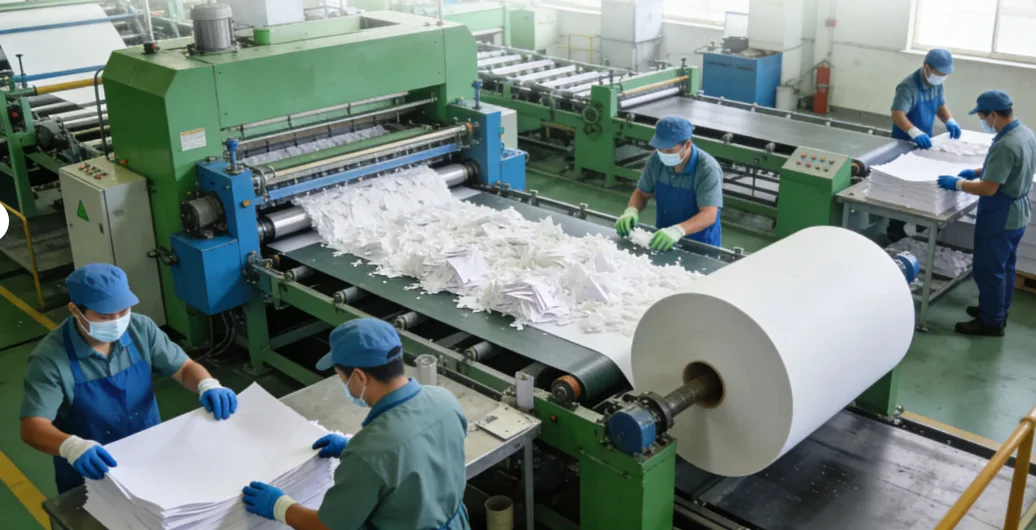
Defining and Mitigating Common Paper Defects in High-Volume Runs
Understanding the terminology of common paper defects is crucial for effective communication with a supplier’s technical team and for minimizing your waste rate.
-
Dusting/Linting: Small paper fibers or filler that detach from the surface and accumulate on the printing blankets and plates.
- Mitigation: Requires paper with high surface strength or use of an on-press web cleaning system.
-
Curl: The paper tends to roll or curve, primarily due to changes in moisture content after exposure to the pressroom environment.
- Mitigation: Ensure paper is properly acclimated to the pressroom’s humidity and temperature before unwrapping.
-
Warp/Skew: Uneven sheets that are not perfectly square, leading to poor registration (misalignment of colors).
- Mitigation: A manufacturing defect. Requires clear supplier replacement policy and improved slitting/sheeting quality control at the mill.
-
Hickies: Small spots on the printed image caused by foreign particles (dust, dried ink, paper coating) adhering to the blanket or plate.
- Mitigation: Paper with high cleanliness standards and a well-maintained press environment.
Key Definition: Runnability is the measure of how successfully paper performs on press. High runnability means minimal downtime, less waste, and high production speeds. Your supplier is directly responsible for delivering high runnability.
Conclusion: Turning Your Paper Supplier into a Strategic Asset
Choosing the right paper supplier for a high-volume printing operation is one of the most significant strategic decisions a print business can make. The process is a detailed risk assessment masquerading as procurement.
By rigorously evaluating the seven critical factors—Capacity and Quality Control, Logistics, Total Cost of Ownership, Sustainability, Technical Support, Financial Terms, and Customization Flexibility—you move beyond a vendor relationship. You establish a partnership that ensures material consistency, optimizes cash flow, minimizes production risk, and ultimately allows your business to deliver exceptional quality on time, every time.
Demand transparency, require verifiable data (like COAs), and insist on a supplier whose infrastructure is designed to support the immense and consistent demand of your high-volume presses.
Frequently Asked Questions (FAQs)
What is JIT delivery and why is it important for paper procurement?
JIT (Just-In-Time) delivery is a logistics strategy where paper is delivered precisely when needed, minimizing the need for the printer to hold large, expensive inventories. For high-volume operations, JIT reduces warehousing costs, lowers inventory carrying risk, and frees up capital that would otherwise be tied up in stock.
What specific paper tests should I request data for from a new supplier?
You should regularly request data on Basis Weight and Caliper (to ensure consistency for folding/binding), Moisture Content (crucial for runnability and avoiding curl), and Opacity (vital for high-quality duplex printing). This quantitative data, often provided via a Certificate of Analysis (COA), proves the supplier’s quality control.
How does my pressroom environment affect the paper I receive?
The environment is critical. Paper is hygroscopic (absorbs moisture). Significant differences between the paper’s moisture content and the pressroom’s humidity and temperature can cause static electricity, curling, and registration problems. Paper should be stored and acclimated in an environment matching the pressroom conditions ($45%-55%$ Relative Humidity and $68^{\circ}F-75^{\circ}F$).
What is the difference between FSC and SFI certification?
FSC (Forest Stewardship Council) is a global, NGO-driven standard often seen as having the strictest chain-of-custody requirements. SFI (Sustainable Forestry Initiative) is a standard prominent in North America. Both certify responsible forest management, but many international clients and RFPs specifically require FSC certification, making it a crucial stock to offer.
Should I choose a paper distributor or buy directly from the mill for high volume?
For the highest volumes (multiple truckloads per month), buying direct from the mill can yield the lowest unit price. However, distributors offer critical advantages: they can provide buffer stock, offer a wider range of specialty papers from various mills, and handle complex logistics, making them the preferred strategic choice for most operations focused on reliable, diverse, and flexible service.